Technology
Well-labeled, neatly arranged in rows
Serial number, barcode, or Data Matrix code: Proper labeling is a crucial component of mass production. It is essential to define requirements clearly and early on.

Serial number, barcode, MAC address, or Data Matrix code: What’s printed on an electronic assembly or a finished device may seem like a minor detail. In mass production, however, proper labeling is an integral part of the product. If it is defined early on, unnecessary effort, additional costs, and delays can be avoided. Jürgen Schönberger, a process engineer at Ginzinger electronic systems, explains what matters most in this regard.
What needs to be on the product?
Since 2008, Jürgen Schönberger has been working on production and testing processes at Ginzinger. After holding positions as a testing and repair technician and as a team leader in the test lab, he has been working as a process engineer since 2019.
His areas of focus include work planning, process development, and customer-specific labeling. When developing an electronic product, the initial focus is on functions, hardware and software, mechanics, or regulatory requirements. The labeling of assemblies, devices, or packaging, on the other hand, often seems like a minor detail. However, there are several questions that need to be clarified:
- What information is required?
- Plain text, barcode, or 2D code?
- Customer serial number, MAC address, or registration data?
- What size and position are possible?
- What environmental conditions must the labeling withstand?
If the requirements are not finalized until shortly before the start of mass production, additional effort may be required. Special formats may require specific materials or dedicated printing systems.
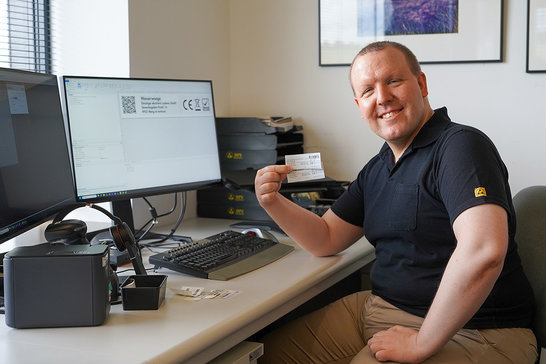
“What looks like a simple label can have implications for materials, printing techniques, production processes, and traceability.”

Laser or glue?
For electronic assemblies, Ginzinger’s preferred standard is laser marking directly onto the printed circuit board, provided it is technically feasible. This is applied automatically at the very beginning of the assembly process. This allows the assembly to be tracked by serial number through the subsequent process steps. At the same time, this reduces manual steps and potential sources of error. If laser marking is not possible or if additional markings are required, labels are used. Depending on the product and requirements, various options are available—ranging from labels and barcodes to Data Matrix and QR codes. The decisive factors are the amount of information, available space, and intended use.
From the serial number to the MAC address
The information required depends on the product and application. For assemblies, Ginzinger typically includes the serial number in plain text and as a Data Matrix code, as well as the production date, as part of the labeling.
Depending on the product and customer requirements, the following may also be included, for example:
- Customer logo and customer serial number
- MAC addresses
- Certification and radio frequency identifiers
- Barcodes and 2D codes
- registration and commissioning data
- customer-specific coding and special formats
It’s important to note that not everything that fits on a label needs to be included. Additional information requires space and can increase the effort involved in data provision, printing, and production. Where possible, Ginzinger therefore relies on existing formats and printing systems. This keeps labeling simple, robust, and cost-effective in series production.
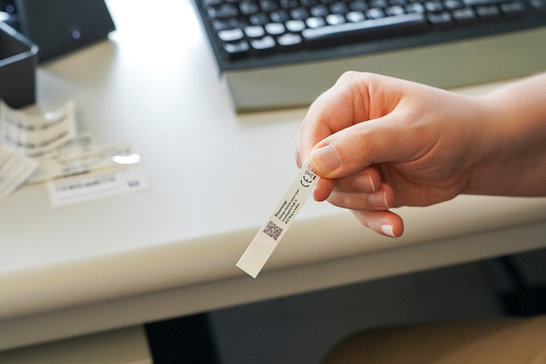
“Sometimes a large amount of information needs to be incorporated into a code that is only a few millimeters in size. In such cases, it is necessary to carefully determine which format makes the most technical sense. But it’s not just the content that matters: Depending on the application, the marking may be exposed to oil, dirt, salt, fuel, moisture, temperature fluctuations, or cleaning agents for years on end. The material and printing process are therefore selected to suit the conditions under which the marking will be used.”
Clarified early on, smooth production
To identify customer-specific requirements even earlier and more clearly, Ginzinger electronic systems has further standardized its labeling procedures. The issue was addressed as a priority for improvement within the framework of Hoshin Kanri, the tool used at Ginzinger for strategy implementation and continuous improvement.
Under the leadership of Jürgen Schönberger, a cross-functional team developed a standardized catalog of requirements. It provides a structured guide to labeling types, mandatory information, and optional details, helping to determine the appropriate solution for mass production.
For Ginzinger’s customers, this means above all that labeling is taken into account early on. For EMS projects, this should ideally happen as early as the product requirements phase; for development projects, it should occur before the transition to mass production. In addition to assemblies, product, shipping, and reusable packaging labels can also be taken into account. Changes can be clearly managed via a central label definition. This ensures that data remains up to date and reduces the effort required for maintenance and coordination throughout the product lifecycle. After all, the best label is the one that no one has to worry about once series production begins.