
Latest
Is there a screw loose in your HMI?
Screwless mechanical designs, modular display families, and customizations: These elements come together to create HMI solutions that can be manufactured efficiently and flexibly adapted to a variety of applications.
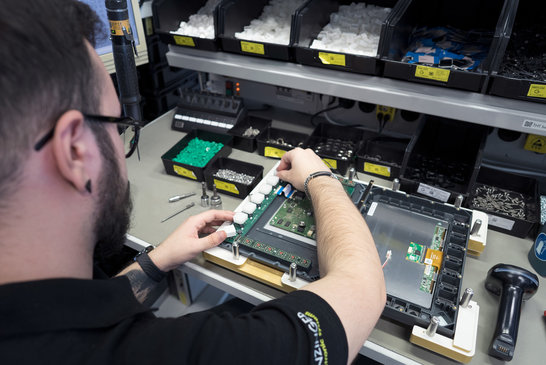
Today, modern HMI (Human Machine Interface) systems must do far more than simply display information or enable user input. Device manufacturers expect solutions that are robust, flexibly customizable, visually appealing, and, at the same time, cost-effective to produce. The demands are particularly high in the industrial, medical technology, and automotive sectors. One possible approach that meets these requirements involves screwless mechanical designs, modular display families, and customer-specific adaptations: This results in HMI solutions that can be manufactured efficiently and flexibly adapted to different applications.
When Traditional Screw Connections Reach Their Limits
Screws have been the standard in equipment manufacturing for decades. In modern HMI systems, however, traditional screw connections can require additional assembly steps that can only be automated to a limited extent.
This becomes particularly relevant as production volumes increase or device designs become more complex: Every additional manual assembly step increases the time required and process costs, and introduces further potential sources of error. That is why Ginzinger is increasingly relying on screwless mechanical designs for its HMI-platforms.
Not easier, but more precise
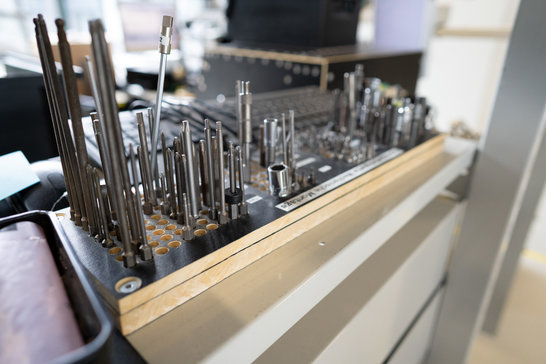
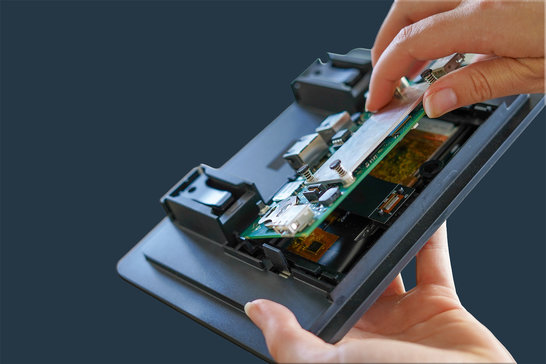
Doing away with screws by no means implies less engineering—quite the contrary: the mechanical design must be executed with significantly greater precision. The solution involves
- precisely engineered plastic clips,
- guided plug-in systems, and
- form-fit connections.
The goal is a tool-free, secure, and repeatable assembly process that is also suitable for standardized and automated production processes.
The real challenge lies in the tolerance chain of the individual components: the housing, printed circuit board, connectors, mechanical guides, and display modules must be coordinated so that the entire system aligns itself precisely during assembly. This becomes particularly critical for plug-in systems with very fine contact pitches, such as those with pitch dimensions of just 0.4 mm. Even minimal deviations can lead to stress, contact problems, or misalignment.
Multi-stage centering mechanisms, self-aligning connector systems, controlled tolerance chains, and standardized connectors counteract this. In addition, the correct assembly of the interfaces can be verified electronically. This results in an assembly that practically positions itself during assembly and makes misalignments immediately apparent.
“A screwless design can simplify many things. The key is that the mechanical components, the circuit board, and the connectors are coordinated in such a way that everything fits together reliably in the end.”

Requirements for Automated Manufacturing
Since no manual screw connections are required, assembly processes can be standardized and automated more easily. The electronic verification of individual assembly steps further supports a controlled manufacturing process.
From a Single Project to a Modular Display Family
In parallel with the mechanical design, Ginzinger is pursuing a second approach: standardized display families that offer a high degree of customization. The available HMI panels are based on a common technological platform and come in display sizes ranging from 4.3“ to 12.1” with resolutions up to 1280 x 800 pixels.
The platform includes, among other features:
- IPS-TFT technology
- multitouch support
- optical bonding
- various cover glass options
- standardized touch controllers
- industrial temperature ranges
This common technological foundation can serve as a starting point for prototypes, mockups, and production units.
Standardized, yet personalized
The features required for an HMI depend on the specific application. For this reason, the following parameters—among others—can be customized within the display family:
- Mechanical integration
- Bonding technologies
- Protection ratings and ruggedness
- Touch controllers
- Cover glass dimensions and glass thicknesses
- Optical properties
- Readability while wearing sunglasses
- Printing and design
While many HMIs are developed as stand-alone solutions, the platform approach allows us to build upon existing solutions. Reusable mechanical designs, standardized electronic components, and scalable software form the technical foundation for this.
This is important when additional product variants, display sizes, or production adjustments need to be implemented without having to redevelop the mechanics, electronics, and software from scratch for each variant.
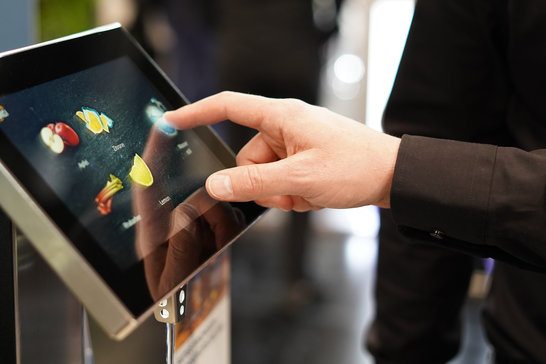
Which display option is right for your application?
The display size, touch technology, cover glass, and other features of an HMI depend on the specific application and environmental conditions. For an overview of the options available from Ginzinger, including key technical specifications, please see our data sheet “Touch Display Variants.”
