Latest
Smart together – 2026 campaign year at Ginzinger
Living cohesion, sharing experiences, and growing as a community
![[Translate to Englisch:]](/fileadmin/_processed_/2/c/csm_01collage_e3ba690cc7.jpg "[Translate to Englisch:]")
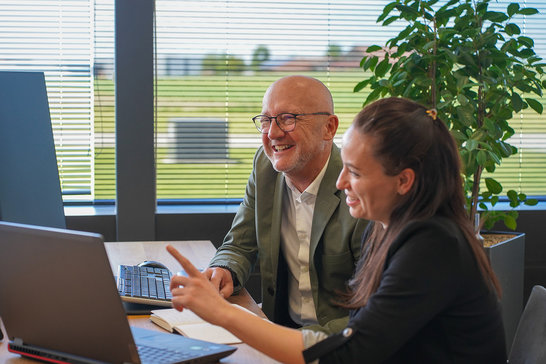
After a year focused on knowledge, at Ginzinger 2026 we are turning our attention to what really strengthens us as a company and a community: cohesion and shared experiences. In our campaign year “g'scheid gemeinsam” (smart together), we want to focus on team spirit, exchange, and genuine connection.
For us, working together means not only working side by side, but also sharing experiences, discovering new things, and growing together. Through various events and team-building activities, such as gaming nights, rock climbing, group cycling trips, or visits to customers, we want to create opportunities to not only work together, but also to share great experiences.
It's not just about fun and shared activities, but also about having an open mindset.

“Sticking together, learning from each other, sharing experiences—that's our motto for 2026. We don't just want to work as a team, we want to grow as a community.”
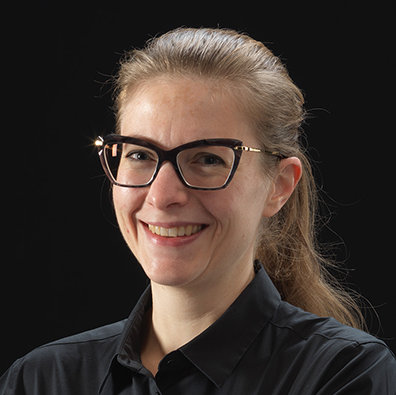
In conversation with Christine Haslinger, Head of HR Management & Organizational Development
Christine, what does community mean to you personally?
Christine: For me, community means taking joint responsibility for the big picture—with clarity, dialogue, and a respectful way of working together. It also means highlighting differences and addressing issues openly. Success comes when cooperation is consciously shaped and provides orientation. This also includes recognizing tensions early on and actively addressing them. Because it is precisely where different perspectives meet that learning, development, and sustainable transformation take place. Ginzinger is already well positioned in this regard. Our aim is to build on these strengths in a targeted manner and continue to shape community in such a way that it has an impact in everyday life—through trust and clear cooperation.
Where do you currently see the biggest challenges—both internally and externally?
Christine: I currently see the biggest challenge in the economic environment. The effects are particularly noticeable in our region. At the same time, global crises, technological upheavals, and issues such as artificial intelligence are causing additional uncertainty for many people. These developments are unsettling for many—and they do not stop at companies. Ginzinger also reacted early to changing conditions and made the necessary adjustments. Today, we are able to hire new employees again This is the result of forward-looking decisions and cooperation that pays off even under difficult conditions. This stability creates reliability—for us as a team as well as for our customers.
Internally, for me, this means above all providing guidance, communicating transparently, and strengthening responsibility. At the same time, we are consciously investing in our professional and technological development and driving new solutions forward. This enables us to remain an organization that is capable of acting and ready for the future.
What positive developments have you noticed since joining Ginzinger?
Christine: Many—especially in the areas of joint goal setting and active development. Ginzinger has been working with Hoshin Kanri for several years. This means that ALL employees work together on clear goals in order to continuously improve. What I find particularly positive is the way these formats are implemented at Ginzinger. They are not rigidly adopted, but consciously adapted to the organization. Feedback from the workforce is taken seriously and incorporated into the further development of the formats. That's exactly what makes the difference.
Methods cannot simply be imposed. They only have an effect when they fit the organization and are co-designed by the people. This not only leads to better goal achievement, but also to high intrinsic motivation and a genuine sense of community.
In addition, there are many positive signs of cooperation in everyday life – for example, in professional and informal exchanges or when employees enjoy spending time together after work. At the same time, we consciously look at where we can improve.
External impulses such as EFQM (European Foundation for Quality Management) help us to systematically reflect on our cooperation and not leave developments to chance.
How do customers benefit from the “Year of Community”?
Christine: When there is good internal cooperation, customers notice this in very concrete terms: through clear contact persons, shorter coordination channels, and teams that remain capable of acting even under pressure. For customers, “smart together” means stable quality, reliable commitments, and solutions that are developed together with them.
For us, true community does not end at the company's boundaries. We see our customers as partners with whom we work on specific challenges – on an equal footing and with a common goal. “G'scheid gemeinsam” is therefore not an internal slogan, but a conscious promise of performance to the outside world.
Christine, thank you very much for the interview!